Why Soft Music is Failing You: The Case for Heavy Neuroacoustics
And a walkthrough of my "Heartbreaker EP" to show art as assessment

We have been conditioned to believe that “calm” sounds like running water, wind chimes, and soft nylon guitars. And sure. Sometimes that’s absolutely true. I’m going out today to do some field recordings in a park and record plants, I get it. lol…
However, for high performers, athletes, and individuals carrying intense psychological friction, this passive backdrop doesn’t always cut it. An overactive mind easily bypasses low-contrast ambient noise. Safe relaxation templates fail to match the real velocity of high-stress lives.
Sound must meet the nervous system where it actually is rather than where it wants to be. If a client is redlined, throwing a soft acoustic loop at them is like trying to brake a runaway truck with a single feather. True regulation requires matching the internal acoustic state first, then guiding it back to safety. We call this the Diagnostic-to-Prescriptive Transition in prescriptive sound design.
My latest release, the Heartbreaker EP, acts as the emotional diagnostic. It is heavy, guitar-driven, indie-alt post-rock. It matches the real, gritty friction of feeling stuck, burned out, and isolated. These songs do not hide from the struggle. They stare directly at it.
But as an artist, I tend to wonder… why leave listeners in the struggle? What if we had a way to help listeners climb out with us? Each of the five tracks on Heartbreaker maps directly to a specific, clinical brainwave entrainment program in my prescriptive sound protocol, Beat Rx. This is sound engineered as a functional tool.
Let me walk you through the album, track by track…
First: We diagnose the internal storm of self-critical loops in track one, “Learn How to Love Me”, then we prescribe 40 Hz Gamma focus to rebuild cognitive unity.
Second: We diagnose the fight-or-flight burnout of track two, “Safe to Say”, then we prescribe 8 Hz Alpha calm to safely down regulate the nervous system.
Third: We diagnose the isolation and toxic quiet of track three, “Alone (Through the Walls)” then we prescribe 28 Hz Beta concentration to re-anchor the mind outward.
Fourth: We diagnose the subconscious regret of track four, “Too Late”, then we prescribe 5 Hz Theta flow to safely process deep-seated memories.
Fifth: We diagnose the battle for presence and hyper-vigilance in track five, “Moments”, then we prescribe deep Delta rest to initiate physical recovery.
This tool is designed specifically for coaches who want a systematic way to help clients express their emotional states. No candles, no crystal bowls, just raw frequencies engineered to shift the brain out of defensive patterns.
If you’re not a coach, that’s okay too. If you’re experiencing any of the above, learning to express through sound is a gift. I’d invite you to explore some of the sounds.
You can listen and purchase the diagnostic album on Subvert & Bandcamp. I’ve attached the links below.
https://www.subvert.fm/miketheschwartz/heartbreaker-ep
If this sounds interesting to you and you’d like to learn more, head to beatrx.miketheschwartz.com - You can test out the brainwave protocol, read the technical manual, preview the soundtracks & brainwave targets, and see if this is a good fit for you and/or your clients.
The complete training protocol and companion tracks go live on August 1st at miketheschwartz.com - if you jump on the waitlist there, I’ll send you a song and a workbook to explore the 6th — and typically most sought after brainwave — Flow.
Shoot me a note if you have any other questions. If you got something from this post, the price of admission is to share it wildly. Thank you.
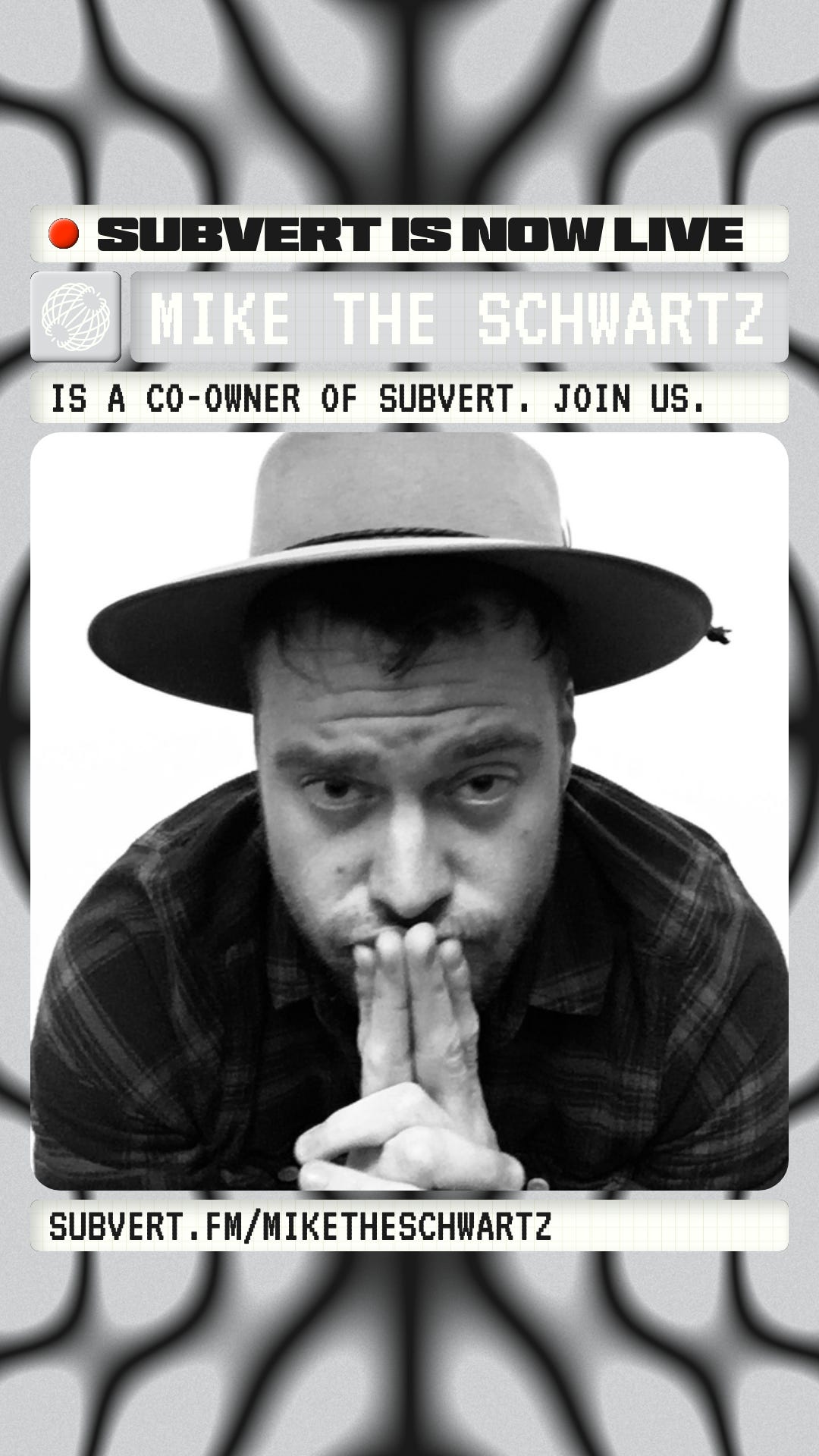
PS. If you’re oassionate about independent art, consider checking out Subvert. They’re a co-op bands, fans and labels who want fair say and fair play when it comes to independent art. You can find my full catalogue for purchase over there soon. For now, look at this cool graphic.